





Pure sine vs modified: which car inverter should I buy?
- My car battery seems to drain quickly when I use my inverter, even for small devices. What's the real impact of an inverter on my car's battery life, and how can I prevent accidental deep discharge?
- I want to run a small microwave or a coffee maker on my road trips. What's the realistic wattage I can expect from a car power inverter without overloading my vehicle's electrical system, and what kind of setup would I need for such high-demand appliances?
- I've heard 'pure sine wave' is crucial for sensitive electronics like my laptop, CPAP machine, or gaming console, but 'modified sine wave' inverters are cheaper. Is the pure sine wave really necessary for these devices in my car, and what are the actual risks if I choose a modified sine wave inverter?
- Installing a high-wattage car power inverter (e.g., 1000W+) seems complicated and potentially dangerous. What are the absolute critical safety precautions and wiring requirements I *must* follow to avoid damaging my car's electrical system or causing a fire?
- I'm confused about calculating the right inverter size for my car. How do I accurately determine the *total continuous wattage* and *peak surge wattage* needed for multiple devices like a mini-fridge, phone chargers, and a portable fan, ensuring I don't buy an undersized or oversized unit?
- There are so many cheap car power inverters online from unknown brands. Are these budget-friendly options reliable and safe for long-term use, or should I always invest in a reputable brand for a good power inverter car setup, even if it costs more?
Choosing a Good Power Inverter for Your Car: Essential Answers for Beginners
As the demand for on-the-go power grows, a reliable car inverter has become an indispensable accessory for many. Whether you're a digital nomad, a road trip enthusiast, or just need to power a small appliance, understanding how to choose and use a good power inverter car solution is crucial. Many beginners face common dilemmas that aren't adequately addressed online. This expert guide dives deep into those pain points, providing comprehensive answers to help you make the best decision for your vehicle's power needs.
My car battery seems to drain quickly when I use my inverter, even for small devices. What's the real impact of an inverter on my car's battery life, and how can I prevent accidental deep discharge?
It's a common misconception that inverters only draw power when a device is plugged in and operating. The reality is that all power inverters, even when idle or powering small devices, consume a certain amount of energy for their internal operation. This is known as 'no-load current draw.' For smaller inverters (under 300W), this might be negligible, but for larger units, it can range from 0.5 to 2 amps per hour. Over several hours, this continuous draw can significantly deplete your car's 12V DC battery, especially if the engine isn't running to recharge it via the alternator.
To prevent accidental deep discharge, which can permanently damage your battery, consider these strategies:
- Engine Running: For any significant power usage, always run your car's engine. The alternator will continuously recharge the battery, preventing discharge.
- Monitor Battery Voltage: Invest in a voltmeter or choose an inverter with a low-voltage alarm/shutdown feature. Most car batteries should not drop below 12.0V (around 50% charge) to avoid damage. A good power inverter car unit will have these built-in protections.
- Disconnect When Not in Use: Even with no-load draw, disconnect the inverter from your car's power source (cigarette lighter or battery terminals) when not actively using it.
- Dedicated Deep Cycle Battery: For high-power, long-duration use (e.g., camping), consider installing a separate deep cycle auxiliary battery. These are designed for sustained discharge and recharge cycles, unlike your car's starting battery.
- Appropriate Sizing: An oversized inverter for your needs will have a higher no-load draw. Choose an inverter that matches your typical power requirements.
I want to run a small microwave or a coffee maker on my road trips. What's the realistic wattage I can expect from a car power inverter without overloading my vehicle's electrical system, and what kind of setup would I need for such high-demand appliances?
Running high-demand appliances like a small microwave (typically 600-1000W) or a coffee maker (800-1500W) from your car requires careful planning and a robust setup. The standard cigarette lighter socket in most cars is fused for only 10-20 amps, which translates to a maximum of 120-240 watts (12V * 10A = 120W; 12V * 20A = 240W). Attempting to draw more will blow the fuse.
To power these appliances, you'll need a high-wattage inverter (at least 1500W continuous, with higher surge capacity) directly wired to your car's battery with heavy-gauge cables. Here's the realistic setup:
- Direct Battery Connection: The inverter must be connected directly to the car battery terminals using thick gauge wiring (e.g., 4 AWG for 1000W, 2 AWG for 1500W, 0 AWG for 2000W+). This minimizes voltage drop and heat buildup.
- Inline Fuse: A high-current inline fuse (rated slightly above the inverter's maximum input current) is absolutely essential, placed as close to the battery as possible, to protect against short circuits.
- Engine Running: The car's engine *must* be running to provide sufficient power from the alternator and prevent rapid battery depletion. Even then, your alternator's capacity (e.g., 100-150A) might be a limiting factor. A 1500W inverter drawing from a 12V source will pull approximately 125 amps (1500W / 12V = 125A), plus inverter efficiency losses.
- Pure Sine Wave Inverter: For motor-driven appliances like microwaves, a pure sine wave inverter is highly recommended for optimal performance and longevity of the appliance.
- Consider Vehicle Limits: Be aware that continuously drawing very high power can strain your vehicle's electrical system and alternator. For prolonged, high-power needs, a separate auxiliary battery bank or a generator might be a more sustainable solution than solely relying on your car's system.
A high-quality car inverter designed for such loads will specify these requirements clearly.
I've heard 'pure sine wave' is crucial for sensitive electronics like my laptop, CPAP machine, or gaming console, but 'modified sine wave' inverters are cheaper. Is the pure sine wave really necessary for these devices in my car, and what are the actual risks if I choose a modified sine wave inverter?
Yes, for sensitive electronics, a pure sine wave inverter is indeed highly recommended, and often necessary. Here's why:
- Pure Sine Wave (PSW): This waveform replicates the smooth, consistent AC power you get from your home wall outlets. It's ideal for all electronics, especially those with sensitive microprocessors, motors, or medical equipment. Devices like laptops, CPAP machines, gaming consoles, laser printers, and anything with a variable speed motor (e.g., blenders, fans with speed control) will operate efficiently and without stress.
- Modified Sine Wave (MSW): This is a stepped approximation of a sine wave. While cheaper, it's a less 'clean' form of power. It works adequately for basic resistive loads like incandescent lights, simple heating elements, and some universal chargers.
Actual Risks of Using MSW with Sensitive Electronics:
- Device Damage: The abrupt voltage changes in an MSW can create heat and stress in sensitive components, potentially shortening the lifespan of your laptop, CPAP machine, or gaming console. In severe cases, it can cause immediate damage.
- Inefficient Operation: Motors in devices may run hotter, noisier, and less efficiently. Power supplies in electronics may struggle, drawing more current and generating more heat.
- Interference: MSW can cause audible hums in audio equipment, visual lines on screens, or interference with radio signals.
- Malfunctions: Some devices, particularly medical equipment like CPAP machines, may not function correctly or at all with an MSW inverter due to their precise power requirements. Many modern smart chargers for laptops also prefer or require pure sine wave input.
While a modified sine wave inverter might save you money upfront, the potential cost of damaging expensive electronics or compromising the functionality of critical medical devices makes a pure sine wave inverter a far better and safer investment for a good power inverter car setup.
Installing a high-wattage car power inverter (e.g., 1000W+) seems complicated and potentially dangerous. What are the absolute critical safety precautions and wiring requirements I *must* follow to avoid damaging my car's electrical system or causing a fire?
You are absolutely right; installing a high-wattage automotive power inverter incorrectly can be extremely dangerous, leading to electrical fires, damage to your vehicle, or serious injury. Here are the critical safety precautions and wiring requirements:
- Disconnect Battery: ALWAYS disconnect the negative (-) terminal of your car's battery before starting any wiring work. This prevents accidental short circuits.
- Correct Wire Gauge: This is paramount. Use heavy-gauge (thick) copper wires for direct battery connections. The gauge depends on the inverter's wattage and the cable length. For example, a 1000W inverter might need 4 AWG for short runs, while a 2000W inverter would require 0 AWG or 2/0 AWG. Undersized wires will overheat, melt insulation, and cause fires. Consult your inverter's manual for specific recommendations.
- Inline Fuse: Install a proper inline fuse holder with a fuse rated slightly higher than the inverter's maximum input current (Amps), as close to the positive (+) battery terminal as possible (within 18 inches). This protects the wiring and your car from catastrophic short circuits.
- Short Cable Runs: Keep battery cables as short as safely possible to minimize voltage drop and resistance.
- Secure Connections: Ensure all connections are tight, clean, and corrosion-free. Loose connections generate heat. Use proper crimp connectors and heat shrink tubing.
- Ventilation: Mount the inverter in a well-ventilated area. Inverters generate heat, and proper airflow prevents overheating. Avoid enclosed spaces or direct sunlight.
- Grounding: Ensure the inverter is properly grounded to the vehicle's chassis, as specified in the manual.
- Professional Installation: If you're unsure, or for very high wattage installations (2000W+), consider professional installation by a qualified auto electrician. This ensures safety and compliance.
Following these steps is non-negotiable for a safe and dependable car power supply.
I'm confused about calculating the right inverter size for my car. How do I accurately determine the *total continuous wattage* and *peak surge wattage* needed for multiple devices like a mini-fridge, phone chargers, and a portable fan, ensuring I don't buy an undersized or oversized unit?
Calculating the correct inverter size is crucial for efficiency and longevity. Here's how to accurately determine your needs:
- List All Devices: Make a list of every device you plan to power simultaneously.
- Find Continuous Wattage: For each device, locate its continuous running wattage. This is usually printed on the device itself, its power adapter, or in its manual. For phone chargers, it's typically very low (e.g., 5-20W). A portable fan might be 20-50W. A mini-fridge is trickier; while its average running wattage might be 50-100W, its compressor has a significant surge.
- Calculate Total Continuous Wattage: Add up the continuous wattage of all devices you expect to run at the same time. This gives you your minimum continuous inverter rating.
- Identify Peak Surge Wattage: This is where many beginners get confused. Devices with motors (refrigerators, blenders, power tools, some fans) require a much higher burst of power (surge) for a fraction of a second when they start up. This surge wattage can be 3 to 7 times their continuous wattage. For a mini-fridge running at 80W, its surge could be 240W to 560W. Identify the device with the highest surge requirement.
- Choose Inverter Size:
- Continuous Rating: Your inverter's continuous wattage rating should be at least 15-20% higher than your calculated total continuous wattage. This provides a safety margin.
- Surge Rating: The inverter's peak surge wattage rating must be higher than the single largest surge requirement among your devices. If your mini-fridge has a 500W surge, your inverter needs to handle at least that.
Example: You want to run a mini-fridge (80W continuous, 500W surge), a laptop (60W continuous), and two phone chargers (20W total continuous).
Total Continuous: 80W + 60W + 20W = 160W.
Highest Surge: 500W (from the mini-fridge).
Recommended Inverter: Look for an inverter with a continuous rating of at least 160W * 1.20 = 192W (so, a 200-300W continuous inverter) and a surge rating of at least 500W. A 400W pure sine wave inverter would be a good, safe choice here, offering ample continuous power and surge capacity.
An accurately sized vehicle inverter solution ensures optimal performance and prevents premature failure of the inverter or connected devices.
There are so many cheap car power inverters online from unknown brands. Are these budget-friendly options reliable and safe for long-term use, or should I always invest in a reputable brand for a good power inverter car setup, even if it costs more?
When it comes to electrical components that interact directly with your vehicle's sensitive electrical system, prioritizing cost over quality can be a costly mistake, both in terms of money and safety. While budget-friendly options from unknown brands might seem appealing, they often come with significant drawbacks:
- Inaccurate Ratings: Many cheap inverters from less reputable brands exaggerate their wattage ratings. A '1000W' inverter might only reliably deliver 500W continuously, leading to frequent overloads and shutdowns.
- Poor Efficiency: Lower-quality components result in higher internal power loss, meaning more of your car's battery power is wasted as heat rather than converted to usable AC power.
- Lack of Safety Features: Reputable brands invest in comprehensive safety features like low-voltage shutdown, over-voltage protection, overload protection, over-temperature shutdown, and short-circuit protection. Cheap units often skimp on these, increasing the risk of damage to your devices, inverter, or even your car's electrical system and potential fire hazards.
- Inferior Components: Cheap inverters often use lower-grade capacitors, transistors, and wiring, which are prone to premature failure, leading to a much shorter lifespan.
- Harmonic Distortion (for MSW): Even for modified sine wave, low-quality inverters can produce a very 'dirty' waveform with high harmonic distortion, which can be detrimental to connected appliances.
- No Customer Support/Warranty: When issues arise, unknown brands typically offer little to no customer support or warranty, leaving you without recourse.
Investing in a reputable brand for a good power inverter car setup, like those offered by CS Inverter, is highly recommended. While the initial cost might be higher, you gain:
- Accurate Specifications: You can trust the stated wattage and performance.
- Robust Safety Features: Peace of mind knowing your vehicle and devices are protected.
- Durability and Longevity: Designed with quality components for years of reliable service.
- Better Performance: More efficient power conversion and cleaner output.
- Customer Support and Warranty: Access to assistance and protection for your investment.
ly, a high-quality car inverter is an investment in convenience, safety, and the longevity of your electronics and vehicle.
Choosing the right power inverter for your car doesn't have to be complicated. By understanding the nuances of battery impact, high-wattage demands, the critical difference between pure sine and modified sine waves for sensitive electronics, essential safety installations, and accurate sizing, you can confidently select a good power inverter car solution. Investing in a reputable brand ensures not only optimal performance but also the safety and longevity of your vehicle's electrical system and your valuable devices. For a dependable car power supply that meets your specific needs, don't compromise on quality.
Ready to power your adventures safely and efficiently? Visit www.csinverter.com or email us at info@csinverter.com for a personalized quote on a high-quality car inverter solution.


OEM & ODM Services
Can I order samples before production?
Yes, we offer sample evaluation and prototype testing.
Pure Sine Wave Inverters
Does it have a charging (UPS) function?
No, this model is a pure inverter without UPS function.
What is the difference between a pure sine wave inverter and a modified sine wave inverter?
Pure sine wave inverter has an output waveform close to mains power with low distortion rate (<3%), which can be safely adapted to precision devices such as computers, medical instruments, and inverter home appliances; modified sine wave inverter has a notched waveform, which easily causes device heating, malfunction or damage, and is only suitable for simple devices such as bulbs and fans.
Can the 3 AC sockets drive high-power devices at the same time?
Yes, but it is necessary to ensure that the total power of the 3 devices does not exceed 2000W (continuous power). For example, it can drive 1 1000W electric oven + 1 500W microwave + 1 400W printer at the same time (total power 1900W), avoiding total power overload to trigger the protection mechanism.
Modified Sine Wave Inverters
Does it support inductive loads?
Modified sine wave inverters are suitable for resistive loads; for inductive loads, pure sine wave models are recommended.
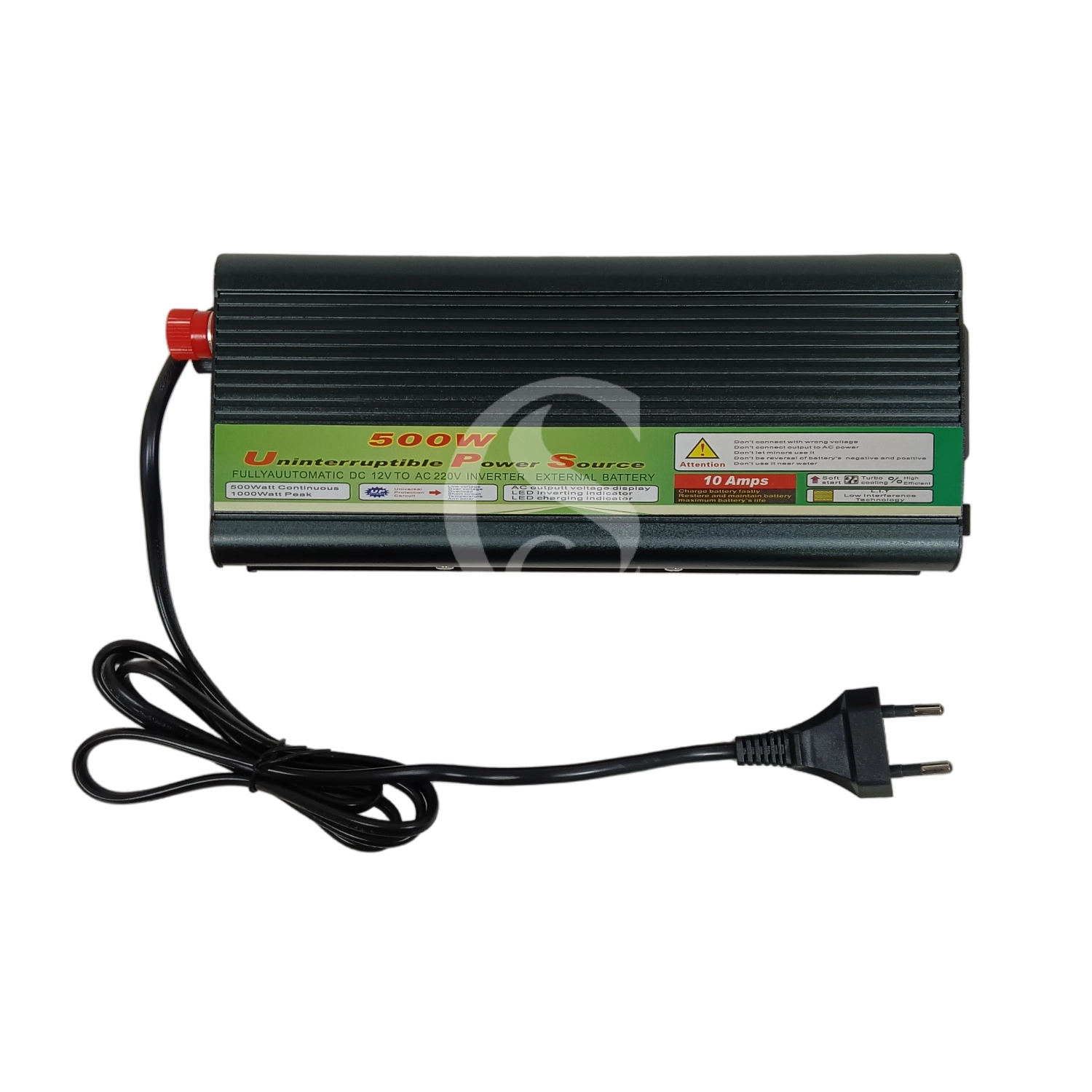
Congsin 500W 12V to 220V inverter delivers reliable off-grid power with its modified sine wave design. This portable 500W DC to AC power inverter efficiently converts 12V DC to 220V AC, ideal for outdoor and emergency use. Trust Congsin for stable, portable energy solutions.
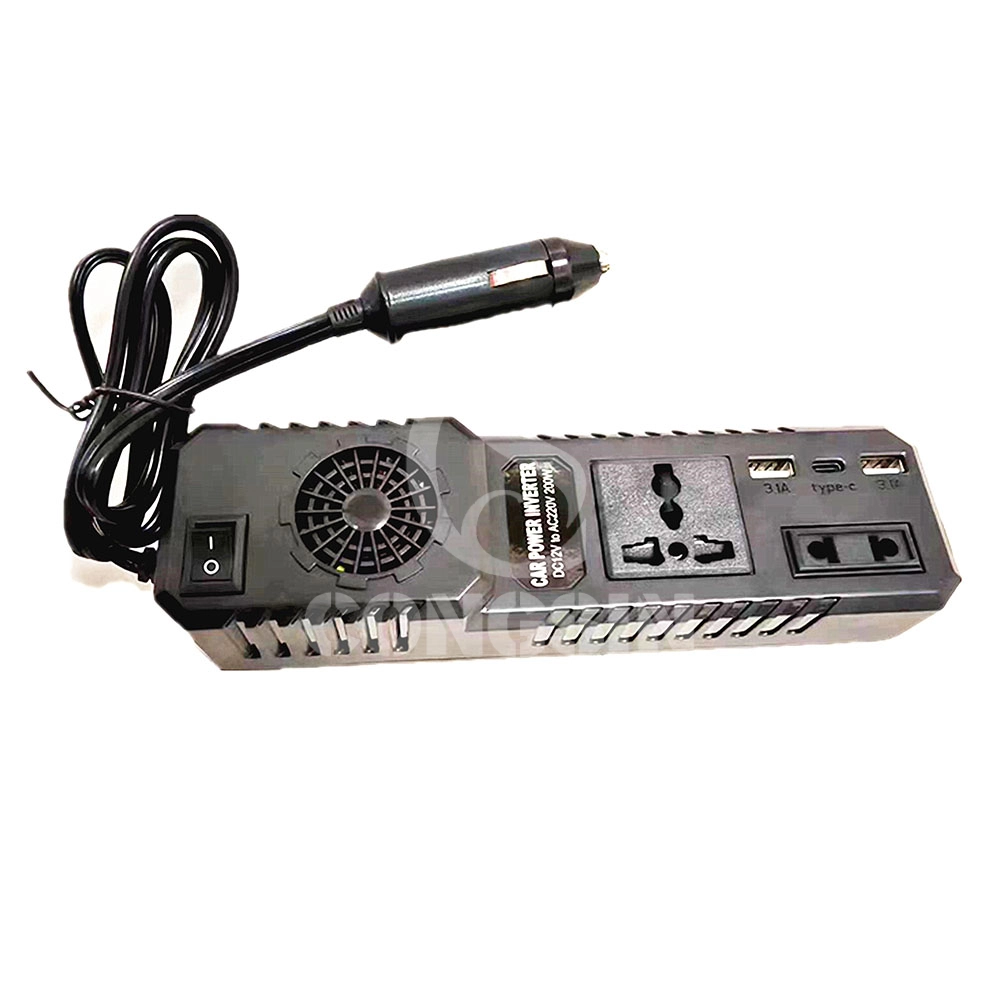
This 200W Modified Sine Wave Car Power Inverter is a compact and practical power conversion device designed for vehicle use. It supports dual input (DC12V/24V) and outputs AC220V, compatible with various electronic devices. Equipped with a Type-C port and dual 3.1A USB outputs, it can charge laptops, phones, cameras, drones, and other small electronics simultaneously—perfect for outdoor travel, emergency backup, and mobile work scenarios.
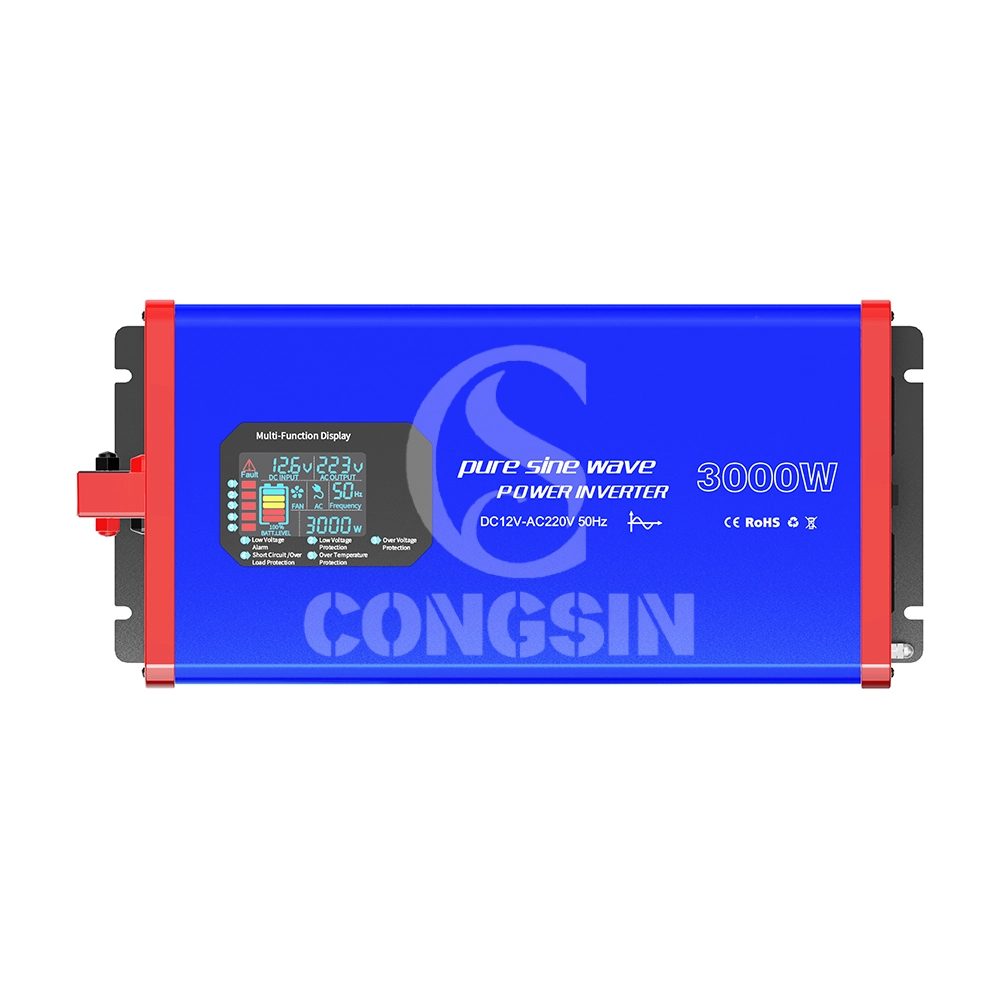
This 3000W full-power pure sine wave inverter (Model: CS3000PSW) adopts pure sine wave output technology (waveform distortion rate <2%), and the output power is highly consistent with mains power quality. It can safely drive high-power precision loads such as air conditioners, refrigerators, medical instruments, and small industrial equipment, avoiding equipment malfunctions or shortened service life caused by unstable waveforms. The device supports DC 12V input (compatible with 10.5V-14.8V wide voltage), continuously outputs 3000W full power, and has a peak power of 6000W, easily coping with the instantaneous startup impact of high-power devices; it is equipped with 4 AC universal sockets (max current 16A) + 2 USB 3.0 fast-charging ports (22.5W per port) to meet the simultaneous power supply needs of multiple devices. Built-in six-fold safety protection (overload, overvoltage, undervoltage, short circuit, overtemperature, reverse connection), combined with dual intelligent silent cooling fans (noise ≤45dB), it achieves the triple advantages of "high power + high safety + low noise," suitable for home emergency, outdoor engineering, vehicle-mounted power supply, small industrial scenarios and other fields.
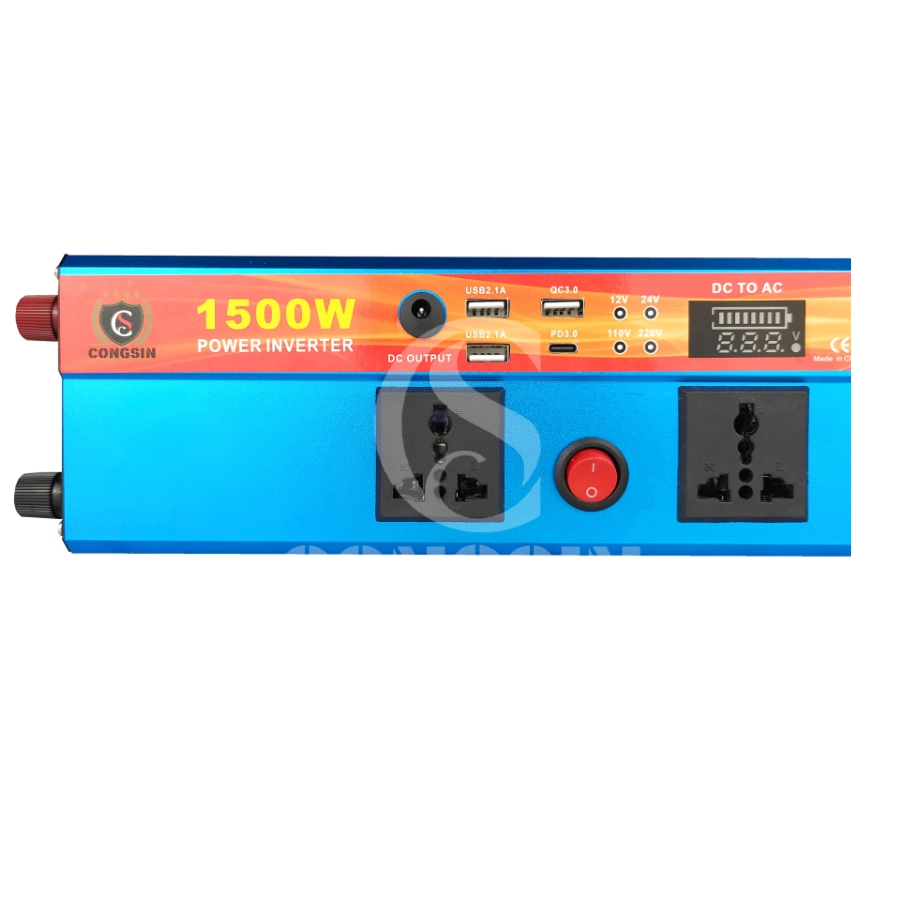
Our CS1000DDBC 1000W modified sine wave inverter is a professional power conversion device that converts DC 12V from batteries into AC 220V electricity. It is designed with user convenience in mind, featuring an LED display for real-time status monitoring, multiple charging ports (3 USB, 1 Type-C, 1 DC 12V) and two universal sockets to power a wide range of devices simultaneously. Its compact size (250×95×55mm) and lightweight design (NW: 0.84kg) make it easy to carry, ideal for outdoor activities, emergency home use, and on-the-go power needs.
Get in Touch with Our Team
You can also communicate with us directly through our online contact form. Please fill in the following information, and our team will contact you as soon as possible after receiving your message.

CONGSIN is a trusted OEM factory for power inverters, solar charge controllers, and DC converters. Reliable solutions for global B2B buyers.
 High Quality
 7/24 Service
 Guaranteed Warranty
© 2025 Congsin. All Rights Reserved.
 WeChat
 Scan QR Code
sin cong
teaimei10
Whatsapp: +8618028086791
Scan QR Code